Truvesta
Full dealing desk intelligence platform for Forex/CFD brokers — scenario lab, exposure tracking, risk signals, and dealer dashboards.
Replaced 3–4 fragmented dealer tools with one audit-grade platform — real-time risk signals, scenario simulation, and tamper-evident decision trails.
Problem
Brokers need fast, explainable risk signals and defensible decision trails — but most dealing desk tools are fragmented dashboards bolted onto legacy systems, with governance enforced only at the application layer.
Role
- Sole engineer — architecture through deployment
- Full-stack: frontend, backend, data model, real-time infra
- Designed and shipped the entire dealing desk workflow
- Governance system design (audit trail, immutability, CI invariants)
Approach
- Built a single integrated platform covering the full dealer workflow: monitoring → simulation → decision → audit
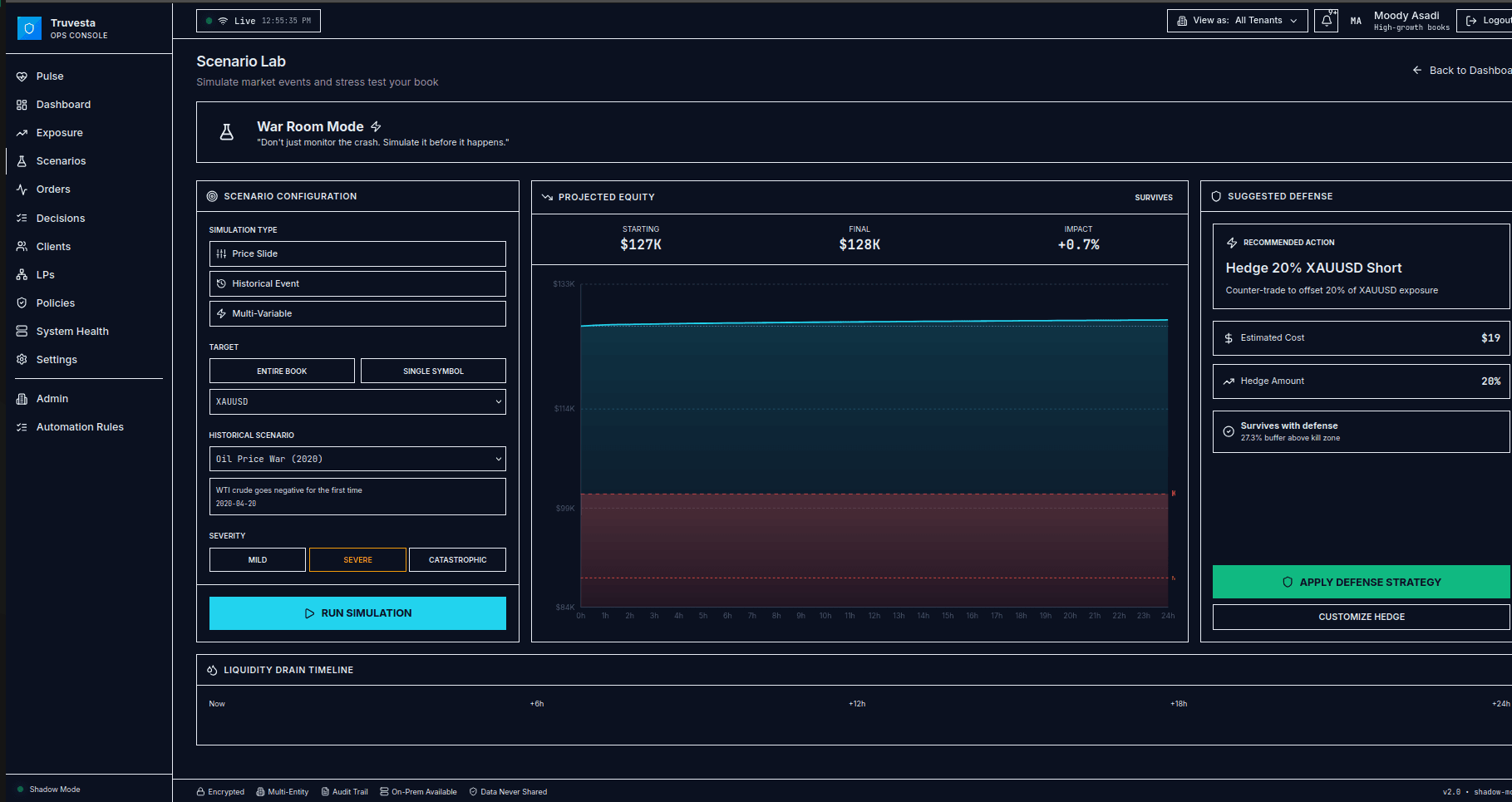
- Scenario Lab with War Room mode: dealers simulate price slates, historical events, and multi-variable scenarios against their live book
- Real-time equity projections with suggested hedging defenses and estimated costs
- Exposure heatmaps across symbols, clients, and LPs — drill from aggregate risk down to individual positions
- Automation rules engine for signal-driven workflows, with human approval gates
- Governance below the application layer: hash-chained audit events, DB-level immutability triggers, CI that actively attacks invariants
Outcomes
- One platform replaces 3–4 fragmented dealer tools
- Dealers can simulate and stress-test before acting — not just react to live exposure
- Tamper-evident audit chain verifiable by any third party
- Zero shortcut paths — async audit writes were explicitly rejected for deterministic traceability
- Scenario Lab: simulate market crashes, stress-test book exposure before they happen
- Dealer-first UX: signal → decision → action, all in one surface
- Shadow mode: system observes and audits, never executes trades
- War Room mode with live equity projections and suggested hedging defenses
- Full sidebar navigation: Pulse, Dashboard, Exposure, Scenarios, Orders, Decisions, Clients, LPs, Policies, System Health, Settings, Admin, Automation Rules
What I refused to build
These constraints are part of the engineering signal: the work stayed useful because the unsafe shortcut paths stayed out.
- R-01Async audit writes — traded convenience for deterministic traceability
- R-02Trade execution paths — shadow mode is a hard invariant, not a toggle
- R-03Auto-hedging without dealer confirmation — system suggests, human decides
Stack
Hiring signal
This is the kind of work I want ASADI AI to make legible first: fintech systems where product direction, architecture, execution, and governance all have to line up.